The White House’s AI Action Plan describes the field as a race for “global dominance” and proposes exporting an American package of chips, models, software, and standards while tightening controls on the computing available to rivals.1 Beijing’s governance plan from the same month promotes open-source communities and shared infrastructure, and a year later its foreign ministry was presenting DeepSeek and Qwen as Chinese contributions to global access.2 Each government wants its models to be what others build on. Both are getting part of what they asked for, from each other’s laboratories.
In August, Cursor described a training system that raised its throughput by about 40 percent on its production hardware. The model being trained, Composer 2.5, starts from Moonshot’s Kimi K2.5. The system it replaced was built around DeepSeek’s DeepEP.3 In one release, Cursor kept one Chinese input and replaced another with its own work. Since April, two House committees have been investigating American companies’ use of Chinese models, Cursor’s earlier Composer among them.4 “Is this model American or Chinese?” is now a question a company can be asked in a congressional letter, and one that any American builder who fine-tunes Qwen should expect.
Composer is the easy case. A base model is the kind of dependency a family tree shows, and a committee can ask about it by name. The harder question concerns the dependencies a family tree does not show. ModSleuth, a system developed by Sanjay Adhikesaven, Sewon Min, and the author, reconstructs a model’s documented history from papers, model cards, dataset cards, and code, then asks the same question of every artifact it finds.5 By its count, Olmo 3’s history contains 89 models and 183 datasets that materially shaped its weights or training data, Nemotron 3’s contains 273 and 560, and the chains run as deep as eight hops. This essay adds one attribute to that graph, the country of the organization that released each artifact, and then asks why the pattern that appears looks the way it does.
The family tree looks mostly domestic. In the documented histories of seven American open releases, organizations in China released about 7 percent of the training datasets and a fifth of the weight parents. The column no family tree has looks different. Of the 336 places where the records say a model generated training data, 173 name a model released in China.6 National labels obscure the transnational technical lineage of AI models. A model takes its nationality from whoever released it last. Its training data was made by whichever models were strongest, downloadable, and free to reuse when it was built, and from late 2024 those models were Chinese.
Where the Chinese models are
Three kinds of ancestor appear in a model’s documented history: the model whose weights it started from, the datasets it trained on, and the models that produced, filtered, rewrote, or judged those datasets. Only the first is a family tree in the usual sense. The third is the least visible: a model that rejects an example shapes the curriculum without contributing a sentence to the surviving corpus. It is also where the ModSleuth paper found most of the action. Across the four releases it audited, 350 verified relationships were models operating on training data, against 28 that were weight lineage.5 The census asks what that finding looks like once each artifact carries the country of its releasing organization.
The answer is the ladder in Figure 1. In the combined histories of the seven releases, organizations in China released 77 of the 1,140 training datasets, or 7 percent; 12 of the 64 weight parents, or 19 percent; and 173 of the 336 models named as generators of training data, or 51.5 percent.6 Counted simply as ancestors, Chinese-released artifacts are 10 percent of Olmo 3’s training history and 14 percent of Nemotron 3’s; counted by what they did, they are half of the generators.7
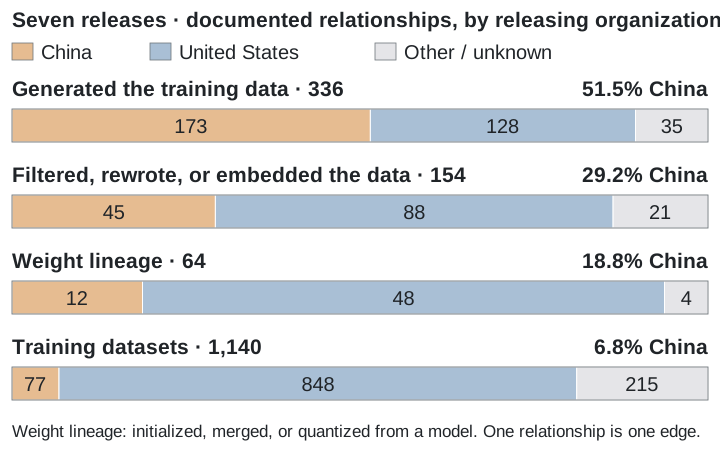
Four bounds apply to every census number in this essay. The census covers the graph published on August 25, 2026, followed forward from seven releases in the Olmo 3, Nemotron 3, DR Tulu, and SmolLM3 families, with each documented relationship counted once. Country is the headquarters of the releasing organization, with Hugging Face kept as its own category. A relationship is one edge however many tokens it carries, and the released graph includes edges the paper did not verify. The seven releases were chosen for their documentation, not to represent the field.8
Most of the aggregate comes from one developer. Chinese-released models performed 169 of Nemotron 3’s 303 documented data operations, or 56 percent, and 53 of Olmo 3’s 229, or 23 percent.7 A token count from the same developer points the same way: NVIDIA’s attribution table for its Nemotron-Pretraining-SFT-v1 corpus lists about 337 billion tokens by generating model, and the rows attributed to DeepSeek and Qwen models sum to about 315 billion, or 93.5 percent.9 Generation is the largest role but not the only one. Olmo 3 uses Qwen3-32B to write the preferred responses in its preference-training pairs and hosts the same model as the judge that scores chat responses during reinforcement learning; the released graph records fourteen relationships between Olmo 3 artifacts and that one Qwen model, none of which a description of Olmo’s weights, trained from scratch, would contain.10 Nor is the pattern confined to the seven releases: Thinking Machines reports bootstrapping Inkling’s post-training with data generated by open-weight models, Kimi K2.5 among them.11
None of this diminishes the publisher’s work. Choosing the prompts, running the generators, deciding which outputs to keep, and training on the result are the labor of making a model, and Cursor’s kernel work on top of Kimi is the converse case, inherited weights and substantial new engineering. The question the ladder raises is different. Chinese-released artifacts are rare among the datasets these releases name and among the weights they start from, and common in exactly one place, the models that made the data. Something about that role selects for them.
Why American labs generate data with Chinese models
The role has requirements the other two do not. A training dataset is usually an inherited artifact, a web crawl or a benchmark or a collection assembled years earlier, and the large ones in these histories are American or Hugging Face releases. A weight parent is usually domestic, because the point of Olmo 3 and Nemotron 3 is to train from scratch. A model that generates training data has to clear three conditions at once. It has to be strong enough that its answers are worth imitating. It has to run at a scale of billions of tokens, which for a laboratory means hosting it locally, which means the weights have to be downloadable. And its outputs have to be released as part of a dataset, which means its license has to allow that.
Each condition is documented in the record. Quality first: when NVIDIA prepared a system for the 2026 International Olympiad in Informatics, it trained one variant on solutions from GLM-5.2 and another on solutions from DeepSeek-V4-Flash, and on its IOI 2025 development set the GLM-trained variant scored 59.4 against 50.7 with shorter outputs, so NVIDIA chose the GLM data for the live run.12 Scale next: Olmo 3 hosts Qwen3-32B on its own servers through vLLM to judge its reinforcement learning, and NVIDIA’s 337-billion-token corpus is the size of thing no API budget produces.10 Then the license. Building Olmo 3, Ai2 wanted to reproduce SwallowMath, a corpus of mathematics web text rewritten into cleaner explanations, but SwallowMath had been rewritten with Llama 3.3 70B Instruct, whose license requires any model trained on Llama outputs to carry “Llama” at the start of its name.13 Ai2’s report gives its reason plainly: to provide truly open data, it mirrored the generation with Qwen3-32B, rewriting the source collection FineMath4+ with the SwallowMath prompt, and released the 5.62-billion-token result as CraneMath.14 An American laboratory chose a Chinese-released generator because the American alternative’s terms conflicted with the release it wanted to make, at the data-generation step, where no weights change hands.
From late 2024 the models that met all three conditions were Chinese. Qwen2.5 arrived in September 2024 under Apache 2.0 for most sizes, DeepSeek-V3 in December, and then the reasoning models: DeepSeek-R1 in January 2025 under MIT, QwQ-32B in March and the Qwen3 family in April under Apache 2.0, DeepSeek-R1-0528 in May under MIT.15 These were the strongest reasoning models anyone could download at the time: DeepSeek reported R1 at parity with OpenAI’s o1 on reasoning benchmarks, and no American laboratory released open reasoning weights of that class until August.16 American frontier models are closed, and their terms of service restrict what may be done with their outputs. Most American open models carried naming or use conditions, Llama’s among them; NVIDIA’s Nemotron-4 340B, released in mid-2024 under a license written to permit synthetic data generation, is the exception, and it is the most-used American open generator in the census. OpenAI’s gpt-oss, released under Apache 2.0 in August 2025, is the first American open model of comparable strength since to meet all three conditions.
Figure 2 dates every generator in the census by the quarter it was released. Among generators released before July 2024, three of 73 relationships name a Chinese model; the column is GPT-4 and GPT-4o, Nemotron-4 340B, Mixtral, Llama, and Gemma. Among generators released since, 170 of 262 do.17 The four most-used generators in the whole census, QwQ-32B, DeepSeek-R1-0528, DeepSeek-R1, and Qwen3-30B-A3B, all appeared between January and May 2025. The most-used American generator released after that is gpt-oss-120b, at eight relationships within months of its release.
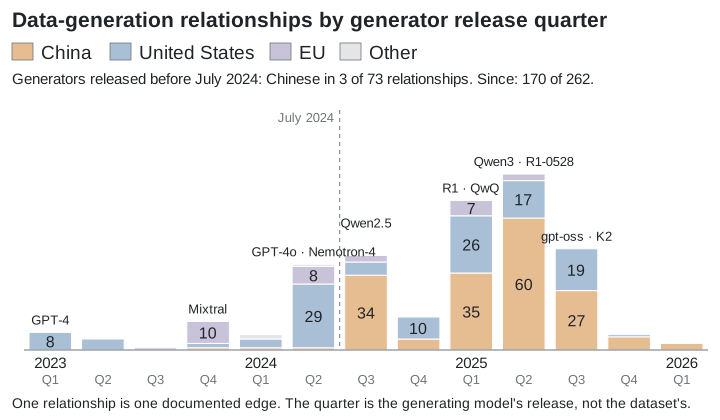
The rule is not “use Chinese models.” American closed models remain in the column as judges and as generators of smaller, high-value sets, GPT-4.1 and GPT-4o among the most frequent, and American open models remain where they lead, Nemotron-4 340B for synthetic chat data, Gemma 3 and Phi-4 for smaller sets. The rule is that a builder takes the strongest model it can download and reuse freely for the job at hand, and the nationality of that model is a fact about the calendar. The generators changed nationality within a year because the strongest downloadable, permissively licensed models did, first the Qwen2.5 chat models and then the reasoning models of 2025.
A lineage keeps every season it passed through. FineMath, the collection Ai2 rewrote for CraneMath, was itself filtered by a quality classifier trained on annotations from Llama 3 70B Instruct, a leading open model of 2024.18 Replacing the rewriter with Qwen3 in 2025 added a layer on top of a Llama layer; it did not remove one. A model’s documented history is stratified in this way, each layer carrying whichever model led open AI in the year it was made, and a national label reads only the surface. If that is the rule, it should show at a single edge, in the other direction, and in earlier years.
Following one math dataset from California to Shanghai and back
One row in NVIDIA’s model card for Nemotron 3 Super Base reads “Synthetic LIMO from DeepSeek-R1-0528,” with LIMO named as the seed dataset and DeepSeek-R1-0528 as the generator. The Nano Base card carries the same row.19 That row is one of the 173 edges, and every hop along it took the strongest freely reusable model of its moment.
LIMO is a dataset of 817 solved mathematics problems built by researchers at Shanghai Jiao Tong University and collaborators in the first half of 2025 and released under Apache 2.0.20 Its problems come from AIME, from the MATH benchmark, from Berkeley’s DeepScaleR collection, and from France’s NuminaMath. Two Chinese-released models chose which problems survived: Qwen2.5-Math-7B-Instruct removed any problem it could solve within four attempts, and DeepSeek-R1-Distill-Qwen-32B kept only those it solved in one to three of thirty-two attempts. Three models then wrote candidate solutions, DeepSeek-R1, the same distilled model, and QwQ-32B, and the best solution per problem was kept.21 NVIDIA took the result as a seed, regenerated the solutions with DeepSeek-R1-0528, among the strongest downloadable reasoning models of that summer, and trained both Nemotron 3 base models on the output. Nemotron 3 Super, the released chat model, is post-trained from Super Base.
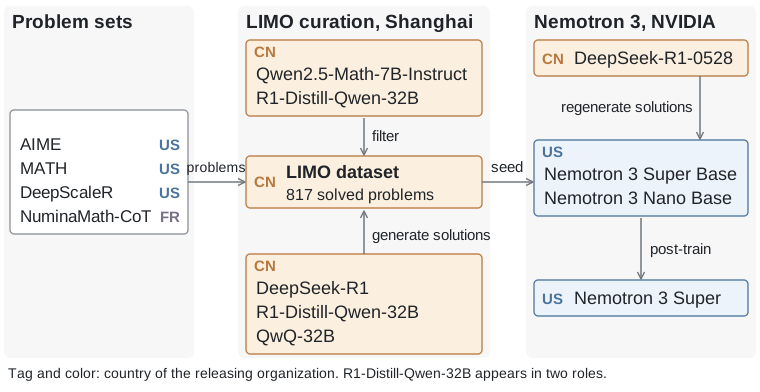
The object changes form at every hop, and the label changes with it. American problem sets become a Chinese curriculum. The Chinese curriculum becomes an American training corpus, written by a Chinese model on an American company’s instructions. The corpus becomes American weights. At each step the artifact is honestly named after the organization that made it, and at each step the name stops describing what went in. By the time the row reaches NVIDIA’s card, “LIMO” is one word standing for four models, four problem sets, and a selection procedure, none of which the reader of the card can see.
Two features of the row make it unusually good documentation. NVIDIA names the seed and the generator in separate columns, so a reader can tell that the solutions are new and the problems inherited; LIMO’s paper names its filters and generators with their sampling rules, so the selection is reproducible. Regeneration did not erase LIMO’s history; what survived it was the selection, which is the expensive part of a curriculum. The margin is thin even so. “LIMO” names both a dataset and a model, and the model is a fine-tune of Qwen2.5-32B-Instruct; read as the model, the same row would become a spurious claim that NVIDIA inherited Qwen weights, and only the seed and generator columns settle which was meant.22 Every hop in Figure 3 was permitted by an open license, LIMO’s Apache 2.0 and DeepSeek’s MIT among them, which is why every hop has a row to cite.
The same thing happened in reverse, a few years earlier
The census can count Chinese work upstream of American releases because the graph was built outward from American releases; its Chinese nodes were mostly never expanded, and only five edges run from a Chinese-released artifact to an American one.8 The reverse direction has to be traced by hand. It is there, and it follows the calendar. When the strongest models anyone could download were American, Chinese laboratories built on them.
Whisper, OpenAI’s 2022 speech model, is the audio encoder Qwen-Audio started from. SigLIP, Google’s 2023 vision encoder, is the one Moonshot’s Kimi K2.5 continued pretraining as MoonViT-3D, and the one DeepSeek-VL combined with Meta’s Segment Anything encoder.23 Llama 3.3, released in December 2024, is the weight parent of two of DeepSeek’s R1 distilled models a month later, and the first version of DeepSeek’s report says why: its reasoning was slightly better than Llama 3.1’s.24 Where American components still lead, the pattern continues; Qwen3-VL initializes its vision encoder from SigLIP 2, released in 2025.23 Kimi K2.5 is the base of Cursor’s Composer, so Composer ends a second chain of the LIMO shape, Google to Moonshot to Cursor, with the American ancestor a component inside the Chinese model rather than a parent of it. The dependency belongs to a version rather than a brand: Moonshot reports training K3’s encoder from scratch.25
Generated data and tasks cross in this direction as well. To turn Kimi-Dev into a software agent, Moonshot fine-tuned it on 5,016 task trajectories from the SWE-smith dataset, collected with Anthropic’s Claude 3.7 Sonnet and published.26 That is the same kind of edge as the 173 counted above, running the other way through a public dataset. Shanghai AI Lab’s Intern-S2 report lists 80,000 tasks from NVIDIA’s Nemotron-Terminal-Synthetic-Tasks as the largest of its public coding and terminal task sources, and adopts a warm-up method from Nemotron 3 Ultra, run with its own expert models.27 NVIDIA is the largest user of Chinese generators in the census and a supplier of training tasks to a Chinese release, in two projects that share no documented lineage.
These cases are hand-traced and cannot be turned into a count. What they show is that the rule is symmetric and the calendar is not: Chinese builders took American encoders and weights when those led open AI, and take American tasks and components where they still do. Everything in this section is documented because the artifact that crossed was open.
Where the paper trail ends
The rule works through open artifacts, and so does the record. A crossing through an open model is easy to write down: the dataset and the generator are public objects with names and licenses, which is why the rows in this census exist. A crossing through a closed model can be written down too, and often is; GPT-4.1 and Claude appear in the census because the laboratories that used them said so, within the providers’ terms. What leaves no row is a crossing the provider’s terms forbid. The recipient has no reason to write it down, and the provider cannot see it in anyone’s dataset card. The asymmetry in the census is therefore partly the world’s and partly the record’s: the census counts what was permitted and disclosed.
Crossings of the third kind surface as accusations. In July, the director of the White House Office of Science and Technology Policy, Michael Kratsios, alleged that Moonshot had distilled Anthropic’s Fable to build Kimi K3. China’s Ministry of Commerce rejected the allegation and accused American firms of distilling Chinese models.28 Each government asserts a crossing through closed models that neither has documented publicly. A public-source method such as ModSleuth shows where the documented lineage ends and cannot confirm or refute what lies past it. Two lines of work with Sewon Min address that gap directly: one tests whether a model learned from a suspected teacher’s outputs by comparing its likelihoods against a reference checkpoint, and one detects training data by fine-tuning a model to reconstruct candidate text.29 The provider’s logs and the recipient’s training records remain the decisive evidence, and governments can compel both in a way the public cannot. The reuse documented in this essay is of published artifacts under their licenses, which in DeepSeek’s case expressly permit distillation; extraction against a provider’s terms is a different act, and the prevalence of the first excuses nothing about the second.30
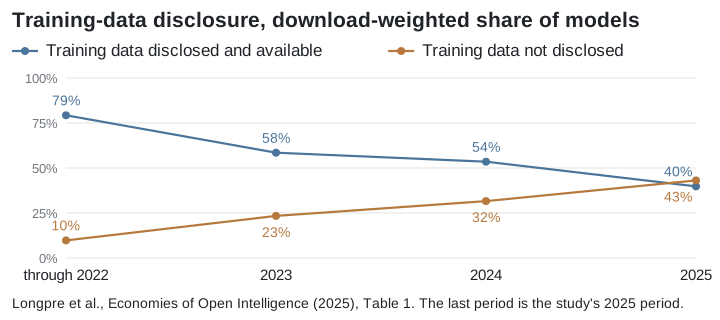
The record is also shrinking. In Longpre and colleagues’ download-weighted study, the share of models with disclosed and available training data fell from 79 percent for releases through 2022 to 40 percent in the study’s final period, while the share with undisclosed data rose from 10 to 43 percent (Figure 4).31 Among downloadable models, disclosed training data is becoming the exception, which moves crossings from the documented kind to the undocumented kind even when the weights themselves are public. Scrutiny, meanwhile, is beginning to reach below the label. In their July 31 letter to DoorDash, two House committee chairmen asked for model and checkpoint versions, modifications such as quantization, hosting arrangements, and cryptographic hashes, separated a hosted service from weights a company runs itself, and acknowledged cost, capability, and customization as reasons to consider a Chinese model.32 Those questions distinguish an artifact from a brand. They stop one step short of the top bar in Figure 1: which models generated, filtered, and judged the training data before the artifact existed. That question has to be asked while the documentation to answer it still exists.
So, is my AI model American or Chinese?
The label has a job. It names the organization accountable for a release, and nothing here argues for taking that away. What it cannot do is allocate credit or direct scrutiny, because the operation that carries the most foreign work in these histories is the one no label and no family tree records. Counting by label makes a country’s contribution easy to see when it ships a competing product and invisible when it helps build someone else’s.
The documented histories support a narrower and firmer conclusion than either government’s allegation. In seven American open releases, the family tree is mostly domestic and the data pipeline is not. Half of the documented generators were released in China, because from late 2024 the strongest models a builder could download and reuse freely were Chinese; the same releases carry Llama and GPT-4 in their older layers and gpt-oss in their newest. In the other direction, Chinese releases document American encoders, weights, trajectories, and tasks inside themselves, from the years when those led. The label records the builder. The lineage records who led open AI in each year the model’s ingredients were made.
That reading changes the question of who “American AI leadership” is for. Meta has an interest in attaching its name to models built with its outputs, Ai2 in releasing a model under its own name and terms, and treating both as one national interest hides the decision the researchers faced; for Ai2’s purposes, access to Qwen expanded what an American laboratory could release. The larger choices, over chips, market access, and procurement, remain the state’s. But on the evidence here, the way into other laboratories’ pipelines is to release the strongest model available under a license that lets its outputs be reused, which is what Qwen and DeepSeek did from late 2024, what the Action Plan says it wants for American models, and what gpt-oss began in August 2025. A restriction on the other side’s open models would land first on the domestic open builders, because theirs are the only pipelines documented well enough to restrict. Whether permissive release is the decisive lever is a hypothesis; one documented supplier decision and one dated flip support it.
On that standard, the organizations that release strong, permissively licensed generators deserve part of the credit for the models trained on their outputs, competitors’ models included, and a model card that names its generators tells a reader more than one that names its country. The nationality of the models that make the data will change again the next time the strongest downloadable model does; the census is a photograph of 2025. The question in the title has a short answer at the top of the graph and a long one underneath. The label belongs to whoever released the model last. The lineage belongs to whoever led open AI when it was built.
The White House, America’s AI Action Plan, July 2025, introduction and pp. 4–5, 20–21. ↩︎
Ministry of Foreign Affairs of China, Global AI Governance Action Plan, July 26, 2025, §§4–6; regular press briefing, July 9, 2026, on open-source AI and the Global South. ↩︎
Stuart Sul et al., Cursor, Mixture-of-Kittens, August 4, 2026. The figures are Cursor’s own measurements of training throughput on GB300 NVL72 hardware, 760.9 to 1,070.2 tokens per second per GPU. The post identifies Kimi K2.5 as Composer 2.5’s base and describes the DeepEP path it replaced. ↩︎
House Committee on Homeland Security, announcement of a joint investigation with the Select Committee on the Chinese Communist Party, April 29, 2026. The Cursor release named there is Composer 2. ↩︎
Sanjay Adhikesaven, Haoxiang Sun, and Sewon Min, Which Models Are Our Models Built On? Auditing Invisible Dependencies in Modern LLMs, 2026. The author of this essay is a co-first author. Dependency counts are the direct-role totals in Table 2 under forward reachability: 89 models and 183 datasets for Olmo 3, 273 and 560 for Nemotron 3 Super. Of the 1,654 verified reachable relationships across the four targets, 350 are upstream operations on training data and 28 are weight lineage (Tables 2 and 3); maximum depth is eight hops for Olmo 3 Instruct and Think (Table 6). Code and explorer. ↩︎ ↩︎
Nationality census of the released ModSleuth graph at commit
48dc4919, August 25, 2026, followed forward from Olmo 3 7B Instruct, Olmo 3 7B Think, Olmo 3 7B Base, Nemotron 3 Super 120B, Nemotron 3 Nano 30B Base, DR Tulu 8B, and SmolLM3 3B Base. Counts by relationship type are in census-by-relation.csv:trained_on77 of 1,140; weight lineage (trained_from,merged_from,quantized_from) 12 of 64;generated_by173 of 336, with 128 American and 32 from Mistral. Across all model-performed data operations (generation, filtering, transformation, embedding, decontamination), Chinese-released models account for 218 of 490; 51 distinct Chinese-released models perform them, QwQ-32B, Qwen3-30B-A3B, Qwen3-32B, DeepSeek-R1-0528, and DeepSeek-R1 most often. The entity attributions and the per-node regions accompany this essay indata/. ↩︎ ↩︎census-family.csv. Model-performed data operations: Nemotron 3, 169 of 303; Olmo 3, 53 of 229; DR Tulu, 3 of 8; SmolLM3, 1 of 6. Training-role ancestors released in China: Nemotron 3, 59 of 413 (14 percent); Olmo 3, 36 of 347 (10 percent). Family histories overlap, so family counts do not sum to the union. ↩︎ ↩︎
Rules and limits are in attribution-rules.txt and census-totals.json. Hugging Face, which released SmolLM3, is headquartered in New York; its namespaces are kept as a separate category so that community uploads on its hub are not counted as American. The seven-release reach set has 1,004 nodes and 2,350 edges; 37 nodes have unknown region; 160 of the 898 organization and artifact attributions are marked low confidence, mostly individuals and unpublished internal sets. The released graph carries verification verdicts only in its per-target files, so the paper’s verified set cannot be reproduced exactly; restricting to those 824 verified edges moves the Chinese share of model-performed data operations from 44 to 39 percent. Of the 268 Chinese-released nodes in the released graph, 222 have no outgoing edges, and 5 of the 561 edges between artifacts released in different regions run from a Chinese-released artifact to an American one, against 350 the other way. ↩︎ ↩︎
NVIDIA, Nemotron-Pretraining-SFT-v1 dataset card, attribution table. Author’s sum of its twenty rows: DeepSeek 166.2 billion plus Qwen 148.6189 billion is 314.8189 billion of 336.5539 billion, or 93.5 percent. Row-level inputs are in nvidia-corpus-tokens.csv. This is a token count for one corpus, not a share of all Nemotron training data. ↩︎
Team Olmo, Olmo 3, §§4.3–4.4: chosen responses in the delta-learning preference pairs are generated by Qwen3 32B with thinking off and rejected responses by Qwen3 0.6B; “for an LM judge we host Qwen3 32B with thinking mode turned off using vLLM.” The released graph holds fourteen edges from Olmo 3 artifacts to Qwen/Qwen3-32B, in the roles generated by, filtered by, used for evaluation, and used for ablation. ↩︎ ↩︎
Thinking Machines Lab, Inkling: Our Open-Weights Model, July 15, 2026, “Training.” Kimi K2.5 is one of the open-weight models named as generators of the initial supervised fine-tuning data; the share and modality of those examples are not specified. ↩︎
Aleksander Ficek et al., Post-Training Language Models for Gold-Medal Performance in Coding Competitions, §5.2, Table 2. IOI 2025 is the development benchmark, distinct from the live IOI 2026 result. Score@1 with partial credit: teachers GLM-5.2 66.0 and DeepSeek-V4-Flash 55.3; students 59.4 and 50.7; mean generated tokens 84,244 and 89,626. No uncertainty intervals are reported. Ai2 makes the same point about its own coding model: the SERA-32B model card describes its performance as largely bounded by its GLM-4.6 teacher. ↩︎
Tokyo Institute of Technology, SwallowMath dataset card: rewritten with Llama-3.3-70B-Instruct and released under the Llama 3.3 Community License. Meta, Llama 3.3 Community License, §1.b.i. ↩︎
Team Olmo, Olmo 3, Appendix A.3.1, “CraneMath”: SwallowMath “was rewritten using a Llama model, which would require that any model trained on this data would need to have ‘Llama’ in the name, according to the Llama Community License. To provide truly open data, we mirror the generation of this dataset, but use Qwen3 32B to rewrite FineMath4+.” Qwen3-32B is released under Apache 2.0. The naming reading is Ai2’s, not a judicial finding. ↩︎
Licenses as declared on the model cards: DeepSeek-R1 and DeepSeek-R1-0528, MIT; DeepSeek-V3, MIT for the code with the DeepSeek model license for the weights, which permits commercial use and derivatives; QwQ-32B, Qwen3-32B, and Qwen2.5-32B-Instruct, Apache 2.0, while the 3B and 72B Qwen2.5 models carry the Qwen license; gpt-oss-120b, Apache 2.0, August 5, 2025; Nemotron-4-340B-Instruct, NVIDIA Open Model License, whose announcement presented the model as a generator of synthetic training data. OpenAI’s terms of use prohibit using outputs to develop competing models, and Anthropic’s commercial terms restrict use of outputs similarly. Meta’s Llama licenses carry the naming clause in note 13; Google’s Gemma is released under its own terms of use. ↩︎
DeepSeek-AI, DeepSeek-R1, abstract: “DeepSeek-R1 achieves performance comparable to OpenAI-o1-1217 on reasoning tasks.” American open releases between January and July 2025 were Gemma 3 (March, Gemma terms), Llama 4 (April, Llama license, no reasoning variant), and Phi-4-reasoning (April, MIT, 14 billion parameters); the first American open reasoning model at the scale of R1 or Qwen3-235B was gpt-oss-120b in August. ↩︎
generators-by-release.csv: each of the 336 generation relationships with the generating model’s region and release month, taken from the model’s announcement or card. Generators released before July 2024: 73 relationships, of which 3 name a Chinese model, 64 an American one, and the rest European or other. Released since: 262 relationships, of which 170 Chinese, 63 American, and 13 European. One relationship, to a personal repository, is undated. Release month is a lower bound on when the dataset was built, so the figure reflects pipeline timing as well as which models were available. ↩︎
Hugging Face, FineMath classifier card, “trained on 1M annotations generated by Llama3-70B-instruct,” and FineMath dataset card. ↩︎
NVIDIA, Nemotron 3 Super 120B Base model card and Nemotron 3 Nano 30B Base model card, training-data tables, row “Synthetic LIMO from DeepSeek-R1-0528 | Text | Undisclosed | LIMO | DeepSeek-R1-0528”, checked September 8, 2026. The Nano 4B Base card lists the same seed. The post-training of Super from Super Base is documented in the Super technical report, Figure 12. All figure edges and their quoted anchors are in limo-source-edges.json. ↩︎
Yixin Ye et al., LIMO: Less Is More for Reasoning, affiliations and §3.1.1. The released dataset holds 817 rows under Apache 2.0; the current version of the paper describes 800 training pairs, and its first version 817. Named sources: AIME, MATH, DeepScaleR-Preview, and NuminaMath-CoT, which are part of a larger candidate pool. Country follows the releasing organization, not the nationality of individual problem authors. ↩︎
LIMO paper, §§3.1.1–3.1.2. Filters: Qwen2.5-Math-7B-Instruct (problems solved within four attempts excluded) and DeepSeek-R1-Distill-Qwen-32B (32 attempts per problem, 1 to 3 successes retained, yielding a 2,125-problem pool). Generators: DeepSeek-R1, the same distilled model, and QwQ-32B, with rule-based scoring of candidate solutions. ↩︎
GAIR/LIMO model; LIMO paper, §4, fine-tuning from Qwen2.5-32B-Instruct. ↩︎
Yunfei Chu et al., Qwen-Audio, audio encoder initialized from Whisper large-v2; Kimi Team, Kimi K2.5: Visual Agentic Intelligence, §§4.2–4.3, MoonViT-3D initialized from SigLIP-SO-400M; Haoyu Lu et al., DeepSeek-VL, hybrid vision encoder combining SigLIP-L and the Segment Anything ViT-B encoder; Qwen Team, Qwen3-VL Technical Report, vision encoder initialized from SigLIP 2. ↩︎ ↩︎
DeepSeek-AI, DeepSeek-R1, §2.4, first version: Llama-3.3 was chosen “because its reasoning capability is slightly better than that of Llama-3.1.” The sentence is absent from the later version. Distilled models: DeepSeek-R1-Distill-Llama-8B and DeepSeek-R1-Distill-Llama-70B. ↩︎
Kimi Team, Kimi K3: Open Frontier Intelligence, §2.4, describes a from-scratch encoder and the stated stability motivation. The SigLIP initialization belongs to K2.5’s history. ↩︎
Kimi Team, Kimi-Dev: Agentless Training as Skill Prior for SWE-Agents, §4.1: “5,016 SWE-Agent trajectories collected with Claude 3.7 Sonnet.” The SWE-smith trajectory release counts 5,017. These are public data, not a direct acquisition from Anthropic’s API. ↩︎
Shanghai AI Laboratory, Intern-S2-Preview, Table 1 and §§4.4.2, 4.5; NVIDIA, Nemotron-Terminal-Synthetic-Tasks. Table 1 covers public coding and terminal task sources, not all Intern-S2 training data. No documented relationship connects these tasks to the corpus in note 9. ↩︎
Michael Kratsios, statement on X, July 22, 2026; Ministry of Commerce of China, response, July 27, 2026. No evidence package accompanied either statement. An independent study of K3’s behavioral similarity to a different Anthropic model, Claude Opus 4.8, calls its own findings inconclusive: Alexander Panfilov et al., Stealing Reasoning Traces from Proprietary LLM APIs, Appendix B. ↩︎
Rajat Rawat et al., Reference-Based Distillation Detection in LLMs; Junjie Oscar Yin et al., Learning to Detect Language Model Training Data via Active Reconstruction. The first needs likelihood access and a suitable reference checkpoint; the second needs fine-tuning access. Neither is part of ModSleuth, and neither has been applied to the K3 allegation. ↩︎
DeepSeek, R1 model card, §7, which states that the license permits distillation; Anthropic, commercial terms. Published-artifact permissions and hosted-service conditions are different instruments and must be read separately. ↩︎
Shayne Longpre et al., Economies of Open Intelligence, Table 1: download-weighted share of models whose training data is disclosed and available, 79.3 percent for releases through 2022, 58.5 in 2023, 53.5 in 2024, and 39.8 in the study’s final period, 2025; not disclosed, 9.8, 23.4, 31.6, and 43.1. Shares reflect the mix of models downloaded, not changes to any one release. Values are in disclosure-trend.csv. ↩︎
House Committee on Homeland Security and Select Committee on the Chinese Communist Party, letter to DoorDash, July 31, 2026, p. 3. ↩︎